When Google first started adding visible watermarks to Gemini-generated images, the conversation mostly focused on that small sparkle icon in the corner. But there is a second, far more sophisticated layer of labeling happening behind the scenes: SynthID, an invisible watermarking system developed by Google DeepMind. Unlike the overlay you can see and remove, SynthID is woven into the fabric of the image itself — and understanding how it works gives you a much clearer picture of where AI content labeling is heading.
What SynthID Actually Does
At its core, SynthID is a neural-network-based watermarking system. During the image generation process, it makes tiny, imperceptible modifications to the pixel values across the entire image. These changes are too subtle for the human eye to detect — we are talking about adjustments of a few intensity levels in individual color channels, spread out across millions of pixels. But a trained classifier can look at the image afterward and determine, with high confidence, whether it carries the SynthID signal.
The key word there is imperceptible. If you place a SynthID-watermarked image next to an unwatermarked version of the same content, you would not be able to tell them apart. The two images look identical. The differences exist at a statistical level that only a machine learning model can detect reliably.
Google first deployed SynthID on Imagen (their earlier image generation model) in 2023 and then extended it to Gemini as the product line expanded. By 2025, the system was active across all of Google's consumer-facing image generation features.
How Is It Different from the Visible Watermark?
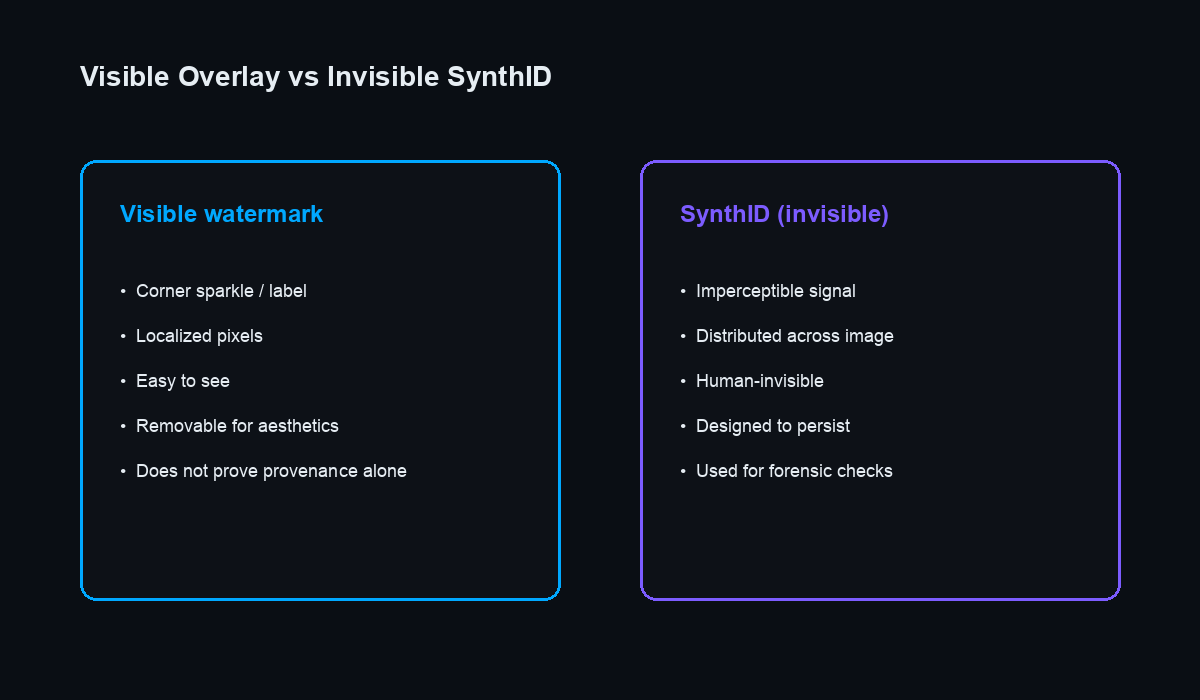
The visible Gemini watermark and SynthID serve different audiences and different purposes. Here is the breakdown:
The visible watermark is meant for anyone who encounters the image. A friend who sees it on Instagram, a journalist reviewing a social media post, or a teacher checking student submissions — all of them can immediately see that the image was generated by AI. It is a social signal, a courtesy label, and it works precisely because it is obvious.
The SynthID invisible watermark, by contrast, is designed for platforms and verification systems. Social media companies can run uploaded images through a SynthID detector to flag AI-generated content at scale. Fact-checking organizations can use it to verify whether a suspicious image came from an AI model. These are automated, high-throughput use cases where a visible watermark may have already been cropped out or obscured.
In practical terms, this means that removing the visible watermark from a Gemini image — using a tool like ours — does not remove SynthID. The invisible signal survives because it is not localized to one corner. It permeates the entire image.
How Robust Is SynthID?
Google has published research showing that SynthID is designed to survive common image transformations. The signal degrades but does not disappear when you:
- Crop the image — since the watermark is distributed across all regions, removing 10 or 20 percent of the image still leaves enough signal for detection.
- Resize or compress — JPEG compression and resolution scaling weaken the signal somewhat, but moderate compression (the kind that social media platforms apply automatically) generally preserves enough for detection.
- Apply filters or color adjustments — brightness, contrast, saturation changes, and Instagram-style filters do not reliably strip the watermark.
- Screenshot the image — re-rendering through a screenshot introduces noise, but the signal is designed to tolerate this.
That said, SynthID is not indestructible. Aggressive manipulations — heavy noise addition, extreme compression, downscaling to very low resolutions and then back up, or running the image through another generative model — can degrade the signal below the detection threshold. There is an ongoing arms race between watermarking robustness and adversarial attacks, much like the historical tension between DRM and piracy circumvention.
Google has been transparent about this trade-off. SynthID is not positioned as a foolproof guarantee. Instead, it is designed to work well for the most common real-world scenarios: images shared on social media, embedded in articles, or forwarded in messaging apps.
The Broader Landscape: C2PA, IPTC, and Content Credentials
SynthID is Google's proprietary approach, but it exists within a much larger ecosystem of AI content labeling efforts. Two initiatives in particular are worth knowing about:
C2PA (Coalition for Content Provenance and Authenticity)
C2PA is an industry standard co-founded by Adobe, Microsoft, Google, Intel, and others. Rather than embedding invisible patterns into pixel data, C2PA attaches a cryptographically signed manifest to the file — essentially a tamper-evident certificate that records where the content came from and how it was created.
If a Gemini-generated image carries a C2PA manifest, any compatible viewer or platform can verify that it was produced by Google's AI and has not been altered since. The limitation is that C2PA manifests live in the file's metadata, which can be stripped by some applications during saving, sharing, or uploading. Many social media platforms strip metadata from uploaded images for privacy and performance reasons, which breaks the C2PA chain.
Google has been involved in C2PA alongside their SynthID work, and the two approaches complement each other. C2PA works when metadata is preserved. SynthID works even when metadata is lost.
IPTC AI Metadata
The International Press Telecommunications Council (IPTC), which sets the metadata standards used by news agencies worldwide, added a "digitSourceType" field to its photo metadata schema in 2023. This field allows image creators to label content as "trainedAlgorithmicMedia" — essentially flagging it as AI-generated within the standard metadata that newsrooms and stock agencies already use.
Like C2PA, IPTC metadata depends on the file retaining its metadata through the distribution chain. Google includes IPTC labels in Gemini output when possible, but this metadata is frequently stripped during social media upload or casual file sharing.
What This Means for You as a User
If you are generating images with Gemini for personal or creative purposes, here is the practical takeaway:
- The visible watermark is the only thing that directly affects how your image looks. It is the one you can remove with a browser-based tool, and doing so gives you a clean image for presentations, social posts, or creative projects.
- SynthID runs silently in the background. It does not affect your image's visual appearance or quality. It is there for platform-level detection, and for most personal use cases, it is irrelevant.
- C2PA and IPTC metadata may be embedded in your image file, but this information is invisible and is often stripped during normal use. If you are uploading to social media or messaging apps, it is unlikely that any end viewer will see these labels.
The broader trend is clear: AI companies are building multiple layers of content provenance into their outputs. Visible watermarks are the most immediate and user-facing layer. Invisible watermarks like SynthID are the forensic layer. And metadata standards like C2PA and IPTC are the institutional layer. Together, they form a defense-in-depth approach to AI content transparency.
Looking Ahead
Invisible watermarking technology is still evolving rapidly. Google continues to refine SynthID's robustness, and other labs — including Meta, OpenAI, and Stability AI — are developing their own approaches. The EU AI Act's disclosure requirements, which are phased in through 2026, will likely push all major AI image generators toward some form of invisible labeling.
For end users, the practical advice stays the same: use the visible watermark remover for the aesthetic issue, stay aware that invisible signals exist for platform-level verification, and be transparent about AI-generated content in contexts where it matters. The tools are available to give you clean images when you need them — and the labeling infrastructure is there to maintain accountability when it counts.